
Topiary & formal trees
Topiary & formal trees
Topiary and formal trees are planned for shape discipline and long-term presentation. Procurement should focus on installation discipline and the establishment-care plan that protects the trained look.
Gallery
Category visual guide
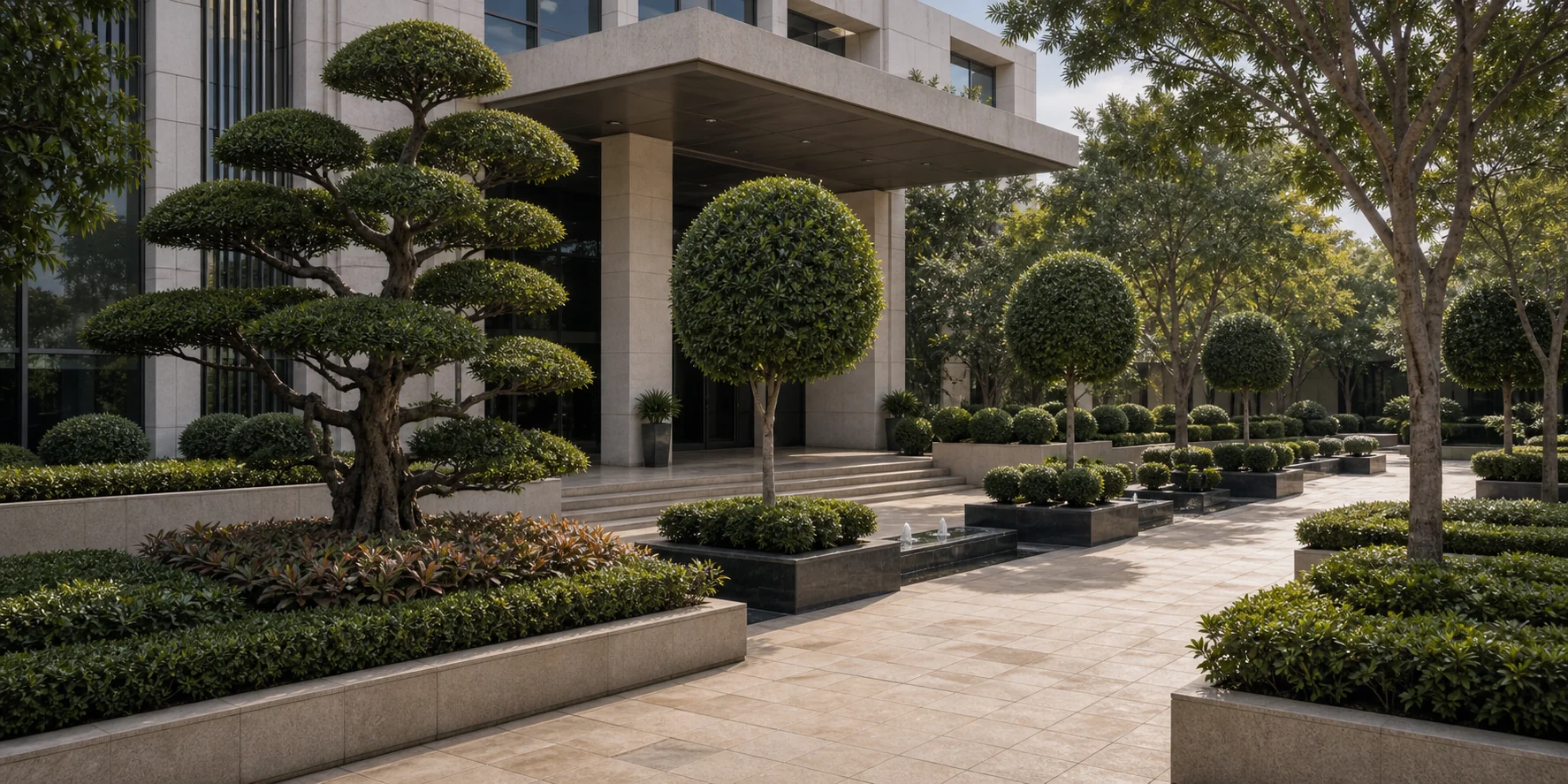
Visual context for placement, scale, handling, and landscape integration.
Section
Installation discipline for shaped presentations
Shape-preserving installation depends on protected handling, careful pit/soil interfaces, and early-stage care. The goal is to reduce stress during transition into local site conditions.
Section
Establishment care boundaries
Define what routine care covers, what triggers maintenance escalation, and how replacement discussions work if the tree’s establishment stage does not meet the agreed outcomes.
Section
Related vertical pages
Entries
In this category
Related
Related links
Services, segments, cost, and proof.
- Which topiary subjects hold a clip in Indian heat and humidity?
- Ficus, Podocarpus, and Euonymus often outperform box and arborvitae on humid coasts — specify climate-fit species before importing Mediterranean forms.
- What clipping cadence should AMC budgets assume?
- Fast subjects (privet, ficus) need monthly touch during growth; slow box and holm oak need less frequent but skilled cuts — cadence is a BOQ line, not implied.
- Pre-trained specimens versus growing the form on site — what changes cost?
- Pre-trained balls/spirals/pleached screens buy instant geometry; on-site training needs years and skilled AMC — procurement chooses time versus capital.
- Can topiary live indoors versus outdoor courts?
- Indoor needs light/HVAC and pest monitoring; outdoor needs monsoon fungus and sun scorch planning — same species may not serve both without different cultivar care.
- When should designers specify Podocarpus instead of box?
- Hot-humid BOQs where box blight and defoliation are likely — Podocarpus cloud and cone forms are among the most reliable Indian topiary subjects.