
Bismarckia palm
Bismarckia palm (Bismarckia nobilis)
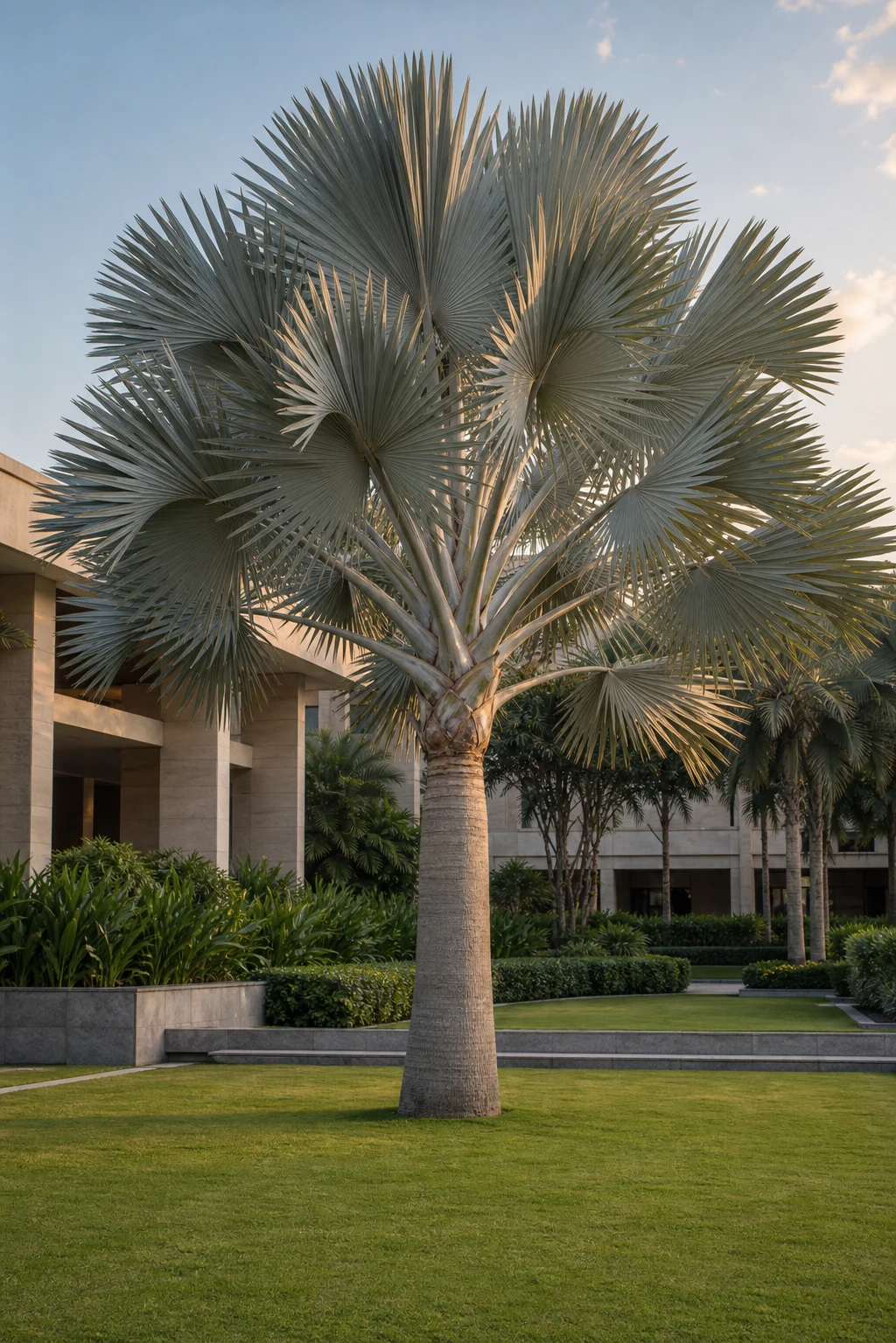
Bismarckia is chosen for a sculptural silver-blue fan crown that reads against green planting — a solitary costapalmate palm for wide arrival plazas and estate forecourts where full sun and generous setbacks exist, not for narrow atrium courts.
Spec
At a glance
- Botanical name
- Bismarckia nobilis
- Family
- Arecaceae
- Common names
- Bismarck palm, Blue Bismarck palm
- Origin
- Madagascar
- Plant type
- Solitary fan palm (costapalmate)
- Mature height
- Often 10–15 m+ in ideal tropical conditions
- Trunk / form
- Stout trunk; stiff silver-blue (or green) fan crown
- Crown spread
- Very wide — often 4–6 m+ across mature fans
- Growth rate
- Moderate; slow to re-establish after large transplant
- Light
- Full sun — crown colour best with high light
- Water needs
- Low to moderate once established; avoid waterlogging
- India climate suitability
- Warm tropical and subtropical India; protect young plants from cold snaps
- Cold/heat & salt/wind tolerance
- Heat- and drought-tolerant once established; moderate frost sensitivity when young; plan wind bracing
- Typical supply size
- Clear-trunk specimen classes [Unverified]
- Lead time (sourcing)
- [Unverified] blue form often scarcer than green in nursery lists
- Install considerations
- Sensitive large rootball; wide pit; bracing; lifting for heavy fan crown
- Maintenance level
- Moderate — periodic frond removal; avoid over-pruning living fans
- Cautions
- Huge crown footprint; large-specimen transplant stress; green form less prized than blue
Supply
Latest import activity
- Imported on
- 28 Jun 2026
- Source
- Flemings Nurseries (sample)
- Availability
- On request
- Lot
- Bismarckia nobilis — silver-blue, 3.5 m clear trunk
Gallery
Specimen visual guide
Visual context for placement, scale, handling, and landscape integration.
Section
Where it's used in premium projects
Design teams specify Bismarckia as a focal counterpoint — silver fans against green massing at hotel arrivals, golf-club forecourts, and wide estate entries. It is not a hedge or screen palm; the BOQ should assume one or few specimens with plaza-scale space, not a tight allée repeat.
Section
Climate & site suitability in India
Full sun across warm India suits established plants; inland heat is tolerable with drainage. Young plants need protection from cold nights in north-India winters. Humid coasts work if pits drain — rot follows wet feet. Narrow courtyards fail when the fan crown outgrows the section within years.
Section
Sourcing & acclimatisation
Buyers specify blue versus green form, clear-trunk height, and fan stiffness — the blue form commands premium and longer nursery lead. Large specimens carry transplant risk because of root mass relative to crown. [Unverified: typical import origin for blue-form field-grown stock.] Hold at nursery with monitored irrigation before hoisting.
Section
Installation (pit, soil, drainage, bracing)
Engineered free-draining pits are non-negotiable — this is a drought-adapted palm, not a swamp palm. Heavy fan crowns need bracing and careful rootball orientation; planting depth must not bury the trunk base. Crane paths must clear the crown spread at delivery — wider than most feather palms.
Section
Establishment & AMC
Post-transplant AMC should track fan wilt, root-zone moisture (not over-watering), and bracing removal timing. Prune only dead fans — over-thinning living blue fans reduces the design value. Replacement clauses matter on large specimens because re-establishment can take multiple seasons.
Section
Cost drivers
Explore
Related
Related
Related links
Services, segments, cost, and proof.
- Softscape & horticulture
- Irrigation & water management
- Landscape maintenance (AMC)
- Hotel & resort landscaping
- Luxury resort & spa landscaping
- Mall & retail landscaping
- Corporate campus landscaping
- Projects
- Commercial landscaping cost guide
- Pricing drivers (imported trees)
- Import compliance workflow
- Request a site assessment
- Blue form versus green form — what should procurement specify?
- Blue Bismarckia nobilis is the premium landscape form; green seedlings are cheaper but do not deliver the silver focal contrast designers specify — name the form on nursery submittals.
- How much setback does the fan crown need?
- Treat mature spread as 4–6 m+ unless your nursery provides a measured specimen — plan glazing, signage, and crane paths outside the fan arc.
- What is the success rate when transplanting large Bismarckia?
- Large fan palms with heavy crowns stress more than small material — success hinges on rootball integrity, drainage, bracing duration, and a written establishment plan, not on generic palm planting notes.
- Can Bismarckia work in a humid coastal resort?
- Yes with free drainage and full sun; pit waterlogging is the common failure — not salt alone.
- Does it need the same irrigation as royal palm?
- No — establishment needs steady moisture, but mature plants tolerate drier regimes than Roystonea; over-irrigation is a common post-handover mistake.
- How should we compare supplier quotations?
- Match form (blue/green), clear-trunk height, crown spread, lifting method, bracing weeks, and AMC — not headline per-tree numbers alone.