
Gallery
Procurement context
Visual references supporting this guide with landscape scope and detailing context.
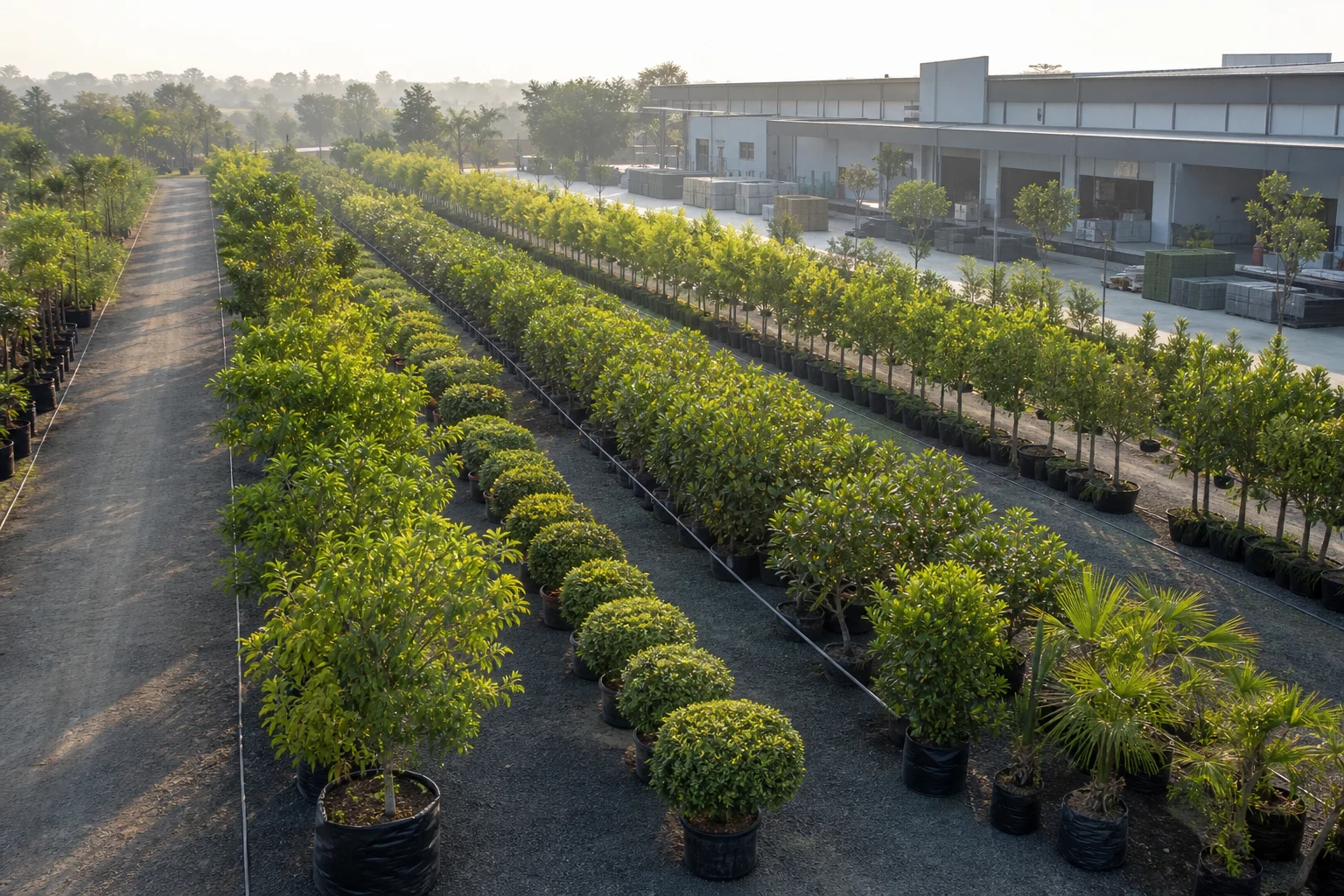



What outcomes should industrial green belt landscaping achieve for procurement?
Define belt outcomes in measurable terms procurement can tender and FM can maintain: buffer widths and species counts as specified in submitted EIA or authority correspondence, dust and view screening along logistics corridors, safe maintenance access without blocking fire lanes or security sightlines, and irrigation reliability on belts that sit far from admin buildings.
Green belts on industrial sites also carry operational risk if treated as cosmetic scope. Procurement should require zone-wise deliverables: perimeter belt, admin arrival edge, amenity buffer, and effluent-adjacent planting with root barrier discipline; not a single lump-sum garden line that hides different establishment durations and irrigation zone counts across bidders.
Which EIA and authority constraints must shape buffer scope?
EIA-aligned belts need installable discipline, not generic greening language. Translate authority inputs into BOQ-ready scope: belt widths and plant counts as specified in submitted documents, spacing that matches expected canopy growth, and species classes that support dust tolerance in the site's heat and monsoon cycles.
Where authority review expects documentation, tender as-built deliverables up front: planting layout records, species class confirmations, irrigation zone mapping, and commissioning logs facilities can produce during audits. Landscaping documentation supports audit review; it does not replace environmental clearance or authority sign-off. Operational reality belongs in scope from day one: trimming windows that preserve HV clearances, maintenance paths crews can use without repeated hot-work permits, and replacement planting rules so the belt stays measurable after the first maintenance cycle.
How does buffer geometry change planting, drainage, and irrigation design?
Buffer depth and shape drive plant spacing, hedge line lengths, hydrozone counts, and how irrigation coverage is validated against the BOQ. Narrow belts of 5-10 m along expressway-facing perimeters need drought-tolerant shrub and groundcover classes at 0.6-1.0 m spacing, with valve isolation so a fault in one section does not shut down the full buffer. Deeper belts of 15-30 m may carry mixed shrub and tree layers at 3-5 m tree centers, staged establishment, and separate 1.5 m maintenance access paths.
Procurement should require documented zoning logic, visibility and safety setback bands along truck routes, and acceptance steps so coverage claims are verifiable at commissioning; not inferred from design drawings alone. Model irrigation zone assumptions with the irrigation system cost tool when BOQ valve counts or controller tiers are still being validated against belt geometry.
What BOQ package structure keeps green belt bids comparable?
Structure industrial green belt BOQ by zone and interface with zone-wise quantities: perimeter belt planting with species class, count, and spacing per 100 m run; soil media depth and drainage layer stacks tied to civil outfalls; irrigation distribution with mainline, laterals, valve count, and controller tier per hydrozone; protective edging and tree pits in vehicle-adjacent areas; root barriers where planting sits near ponds, STP edges, or effluent-sensitive zones; and establishment care with 12-18 month duration and replacement thresholds through the first growing season.
Interfaces must be explicit in tender documents: civil owns structural falls and outfall connections where relevant, MEP owns electrical feeders for pumps and controllers, and landscape owns supply and installation within agreed limits. Cross-check package names with your landscape BOQ format guide and RFP tender checklist so evaluation matrices reward comparable breakdowns, not headline totals alone.
How should landscaping phase around active factory operations?
Phasing is non-negotiable on running plants because hot-work permits, truck movement corridors, safety isolation zones, and production access gates constrain when excavation, trenching, and irrigation installation can occur. Plan delivery around operational calendars: holiday or night windows, section shutdowns, and dust-control requirements during soil media placement.
Establishment success depends on sequencing drainage layers, irrigation commissioning, and initial watering so roots establish in viable windows; not into waterlogged or compacted substrate after truck movement. Protect finished edges from logistics traffic, and tie interface checkpoints to zone release so drains, valve boxes, and paving are ready before production resumes in adjacent areas. Align phasing language with your project phases and handover guide when multiple belts release on different dates.
Which drainage and access interfaces must be named before mobilisation?
Clarify drainage outfalls, slope responsibilities (typically 1:100 to 1:200 toward outfalls), and interface ownership where civil works meet landscape scope. Record ponding risk at belt low points, channel continuity through mulch and edging, and post-monsoon observation windows before hardscape and planting closeout.
Industrial sites also require maintenance access planning in the design scope: service paths wide enough for equipment, valve boxes that crews can reach under EHS induction rules, and trimming schedules that preserve HV and utility clearances year after year. When STP or treated water feeds irrigation, document water quality assumptions, filtration responsibilities, valve isolation per zone, and controller tier (basic timer versus multi-zone smart) in the BOQ preamble so bidders do not price different operating realities under the same heading.
What QA hold points prove belt commissioning before handover?
Name hold points procurement can enforce: civil base and drainage layer verification, controlled wetting or early monsoon drainage observation, irrigation zone coverage with controller records and valve charts, planting establishment stages with replacement thresholds, and signed acceptance logs per belt zone.
QA language should tie to payment milestones and FM handover evidence; not a single practical-completion walk that leaves remote belts without traceable commissioning logs. Align hold-point names with your landscape QA checklist so site supervision, PMC, and facilities teams share the same acceptance vocabulary from mobilisation through turnover.
How should establishment care and AMC protect belt survival after year one?
Year-one establishment is heavier than steady-state AMC: irrigation tuning through heat and monsoon transitions, replacement planting at wear hotspots near logistics paths, and storm debris response after peak rainfall. Establishment care belongs in the construction BOQ with defined duration and replacement allowances; deferring survival obligations to an informal AMC conversation after handover shifts cost when mortality exceeds expectations.
Industrial AMC must be operationally enforceable: perimeter pruning that preserves HV clearances, litter and debris response within agreed hours, irrigation fault isolation on long lateral runs, reporting cadence FM can audit, and an inclusive replacement budget by zone. Tender separate lines for visit frequency by zone, resident versus scheduled crew model, and storm response tiers. Model AMC boundaries with the landscape maintenance AMC calculator before contract approval, and cross-check SLA language with your AMC scope guide.
What common green belt mistakes create rework after scope freeze?
Recurring gaps include: belts priced as lump-sum planting without zone breakdown, irrigation commissioned without valve isolation on remote perimeters, soil media mismatch that drives early decline under dust and compaction, and silent drainage exclusions that surface as ponding after the first monsoon.
A second failure mode is paper compliance: a belt that looks green at handover but cannot be maintained to authority expectations because access paths, trimming schedules, or replacement budgets were never tendered. Treat unsupported establishment assumptions as bid risk until backed by written establishment care, hold points, and comparable BOQ deliverables.
What should procurement do before tender lock?
Draft green belt BOQ structure from this framework, align with EIA or authority inputs already on the plot plan, and circulate tender documents with assumption schedules for soil discovery, water source quality, plant lead times, and phasing constraints on active operations.
Use the commercial cost guide and landscaping cost calculator to sanity-check scenario ranges before release. Review the industrial landscaping segment page for national scope discipline, the Delhi NCR industrial corridor page when Manesar- or Bawal-area mobilisation applies, and the projects portfolio for commercial execution depth; not planting photos alone.
When drainage outfalls, HV clearances, effluent-adjacent locations, or occupied-site access cannot be confirmed from drawings alone, request a site assessment through contact so belt geometry, interfaces, and AMC pricing reflect field realities before contract signature.